AI IS REDEFINING CORPORATE LEARNING
Since the rapid rise of generative AI tools, many companies have been trying to understand how artificial intelligence can be integrated into their learning and development strategies.
In many cases, the first use cases remain relatively simple: content generation, automatic quiz creation, document summarization, or assistance with instructional design.
These applications represent an important evolution, but they do not fundamentally transform the learning experience itself.
Because the true potential of AI in learning does not lie solely in its ability to produce content faster.
It lies in its ability to make learning more interactive, more personalized, and much closer to real work situations.
THE LIMITATIONS OF TRADITIONAL E-LEARNING
For many years, learning platforms mainly operated through a top-down approach.
Employees watched videos, read content, or completed relatively linear modules. These formats made it possible to distribute knowledge at scale, but they quickly reached their limits when it came to developing practical skills.
Understanding a concept does not necessarily mean knowing how to apply it in a real-world situation.
And this gap largely explains why many digital training programs still generate limited engagement and often produce weak operational results. Complement itself highlights that only 7% of learners complete non-mandatory training in traditional e-learning formats.
RECREATING THE EXPERIENCE OF ONE-TO-ONE LEARNING
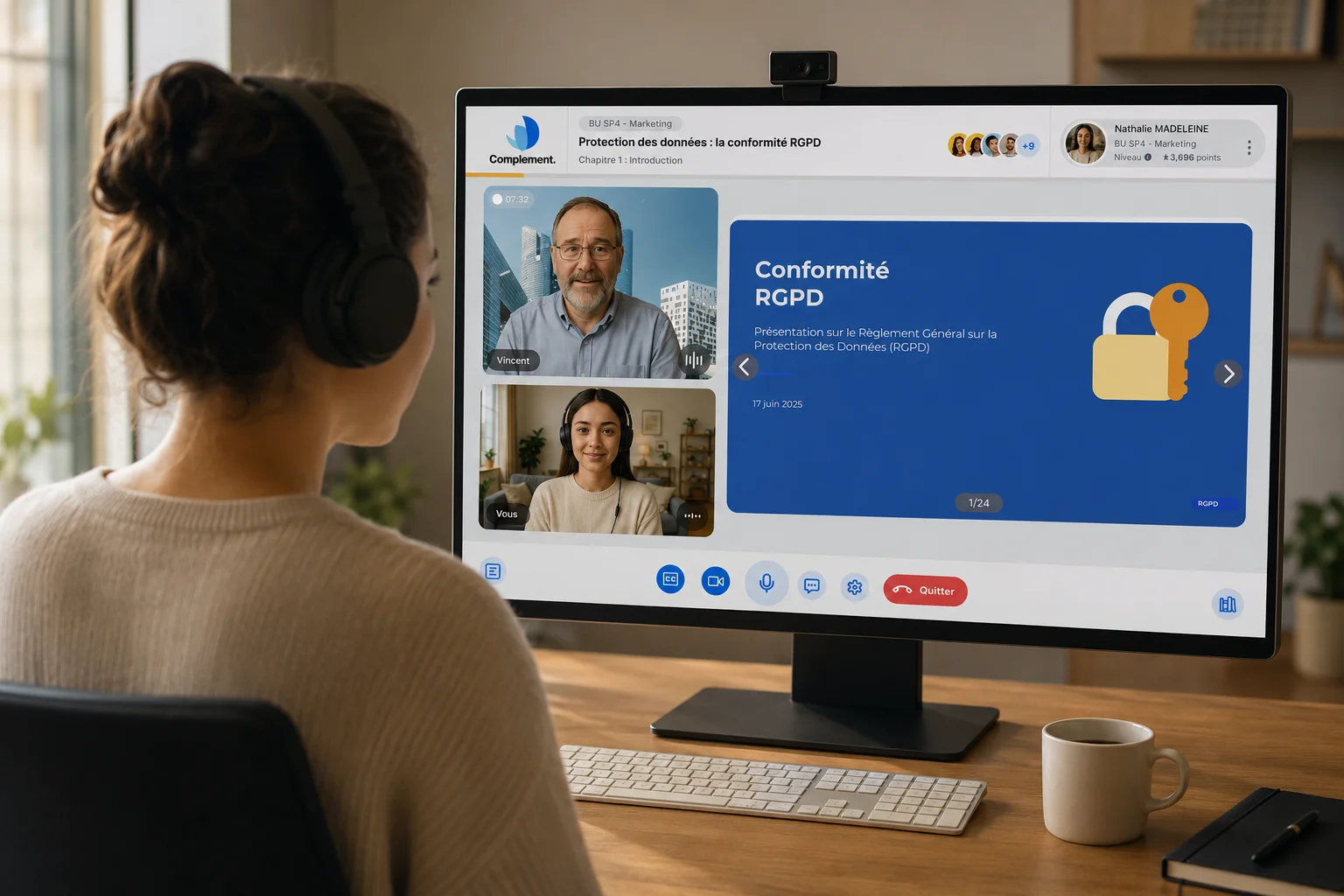
One of the core ideas behind Complement is to recreate what remains one of the most effective forms of learning: a personalized interaction with an expert capable of explaining concepts, asking questions, adapting explanations, and responding to learner difficulties in real time.
To achieve this, the platform uses conversational AI avatars capable of interacting orally with learners. The objective is no longer simply to deliver content, but to create genuine pedagogical interaction.
Learners can ask questions, respond verbally, be challenged on specific concepts, and receive contextualized feedback throughout their progression.
This fundamentally changes the way employees experience learning. They no longer simply follow a static module; they participate in a far more dynamic and engaging experience.
LEARNING THAT ADAPTS TO EACH INDIVIDUAL
One of AI’s greatest contributions to learning lies in personalization.
Adaptive learning platforms use learner responses, behaviors, and progression data to gradually adjust learning paths. Multiple studies now show that AI can help create much more individualized and effective learning experiences.
This is precisely the approach Complement aims to apply.
The platform adapts interactions, questions, and feedback according to each learner’s responses. Learning becomes less linear and significantly more contextualized.
Not all employees learn at the same pace or in the same way. Some require more practice, while others benefit from reformulations or more concrete examples.
AI makes this level of personalization scalable.
MAKING LEARNING MORE ACTIVE
Another major transformation concerns the role of practice.
In traditional learning formats, employees often remain passive in front of content. They watch, read, or click “next” without truly mobilizing their knowledge.
With a conversational and adaptive approach, learning becomes far more active.
Learners must answer questions, explain concepts in their own words, make decisions, and react to situations closely connected to real work environments. Complement notably integrates interactive oral assessments directly into learning journeys.
This approach brings learning much closer to the real conditions in which skills will actually be used.
AI AS A TOOL FOR CONTINUOUS IMPROVEMENT
Artificial intelligence is not only used to personalize the learner experience.
It also helps organizations better understand what works - and what does not - within training programs.
Through oral interactions and learner responses, Complement collects detailed feedback that helps identify misunderstood concepts, recurring difficulties, and friction points within learning paths.
This analytical capability opens the door to a much more refined continuous improvement process than traditional learning systems typically allow.
Training is no longer static content published once and left unchanged.
It becomes a living system capable of continuously evolving based on real learner usage and interactions.
THE GOAL IS NOT TO REPLACE TRAINERS
AI is transforming learning tools, but it does not replace human expertise.
Complement’s objective is not to eliminate trainers or subject-matter experts. It is to make their knowledge more accessible, interactive, and scalable through conversational experiences capable of reproducing some of the dynamics of one-to-one guidance.
AI therefore becomes a way to bring learning closer to employees’ real needs while allowing companies to produce and deploy training much faster. Complement notably states that a module can be created up to 20 times faster than with traditional authoring approaches.
THE REAL CHALLENGE: MAKING LEARNING TRULY USEFUL
Ultimately, this is not only a technological issue.
The real challenge is understanding how to make learning more useful, more engaging, and more effective in an environment where skills are constantly evolving.
The companies that will likely succeed most in this transformation will be those using AI not simply to produce more content, but to create learning experiences that genuinely help employees grow and improve.
Sources
- Complement Education l AI-powered e-learning platform
- Springer l Artificial Intelligence in Adaptive Education
- ScienceDirect l AI-enabled Adaptive Learning Platforms
- Coursera l Adaptive Learning Platforms