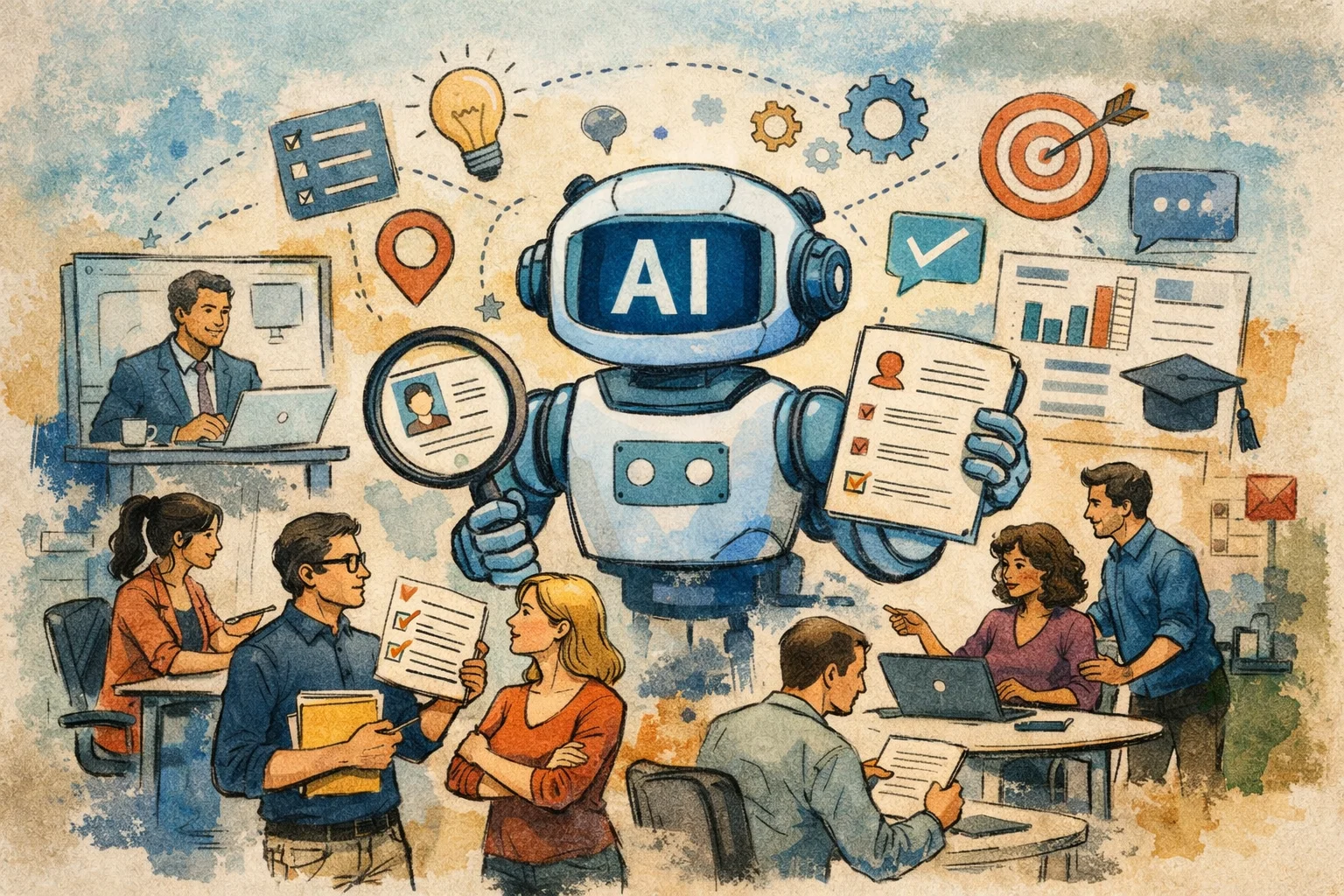
Generative artificial intelligence is profoundly transforming HR functions. From recruitment to training and skills management, the opportunities are vast. Yet, its implementation remains limited in many organizations.
While the tools are now widely accessible, the real challenge lies elsewhere: shifting from individual, often experimental use to concrete, structured applications deployed at scale.
From Fear to Ownership: An Ongoing Transition
The adoption of AI in business often begins with a phase of skepticism. Some employees fear being replaced, while others feel overwhelmed by the technology or struggle to identify relevant use cases.
However, the reality is more nuanced. According to the World Economic Forum (2023), 75% of companies plan to adopt AI, but it is transforming jobs more than it is replacing them. For its part, McKinsey estimates that up to 70% of tasks can be partially automated, which paradoxically reinforces the importance of human skills.
In practice, a breakthrough often occurs after a period of repeated use: employees gradually move from a testing phase to actual business application.
Use Cases Still Too Limited in HR
Today, many HR teams are already using AI, but primarily for simple tasks like content writing, document summarizing, or rephrasing. AI is still perceived as an improved office tool, without real integration into business processes.
In many organizations, use cases are not clearly defined. Teams experiment in isolation, which limits gains and reduces the overall impact on HR performance.
High-Impact HR Use Cases
To create value, AI must be directly integrated into business processes.
In recruitment, it allows for the analysis and comparison of applications, the identification of key skills, and the generation of profile summaries, improving both the speed and objectivity of decisions.
In the context of annual reviews and performance management, it helps define measurable goals, structure evaluation criteria, and draft more qualitative feedback, thereby helping to standardize practices.
Finally, for HR information processing, AI facilitates the summarization of complex documents, automated translation, and the simplification of legal content, making information more accessible and actionable.
The Turning Point: Training and Concrete Use Cases
Scaling does not rely on the tools, but on training and supporting teams. A common mistake is providing AI tools without support, assuming that this will be enough to transform practices. In reality, it is not.
Organizations that succeed in their transformation adopt a structured approach. They offer training directly linked to business use cases, with concrete HR scenarios and practical exercises that allow for immediate application.
They also prioritize progressive learning, based on short formats, continuous skill development, and repeated usage. The goal is not to understand AI in theory, but to know how to use it effectively.
Furthermore, they foster a collective dynamic by developing communities of “key users,” encouraging the sharing of best practices, and facilitating peer-to-peer learning. AI then becomes a collective lever rather than an individual use.
Finally, they launch cross-functional projects involving HR, operational teams, and business lines to identify and deploy shared use cases.
According to the LinkedIn Workplace Learning Report (2024), AI-related skills are among the most in-demand, but also among the most difficult to deploy without appropriate training.
Governing Usage: Reliability and Compliance
Integrating AI into HR raises critical issues, particularly regarding data protection (GDPR), sensitive data processing, and the reliability of generated content.
It is therefore essential to define a clear usage framework, establish validation rules, and rely on trustworthy sources to secure its application.
HR and AI: A Transformation of the Role
AI does not replace HR; it redefines their role. By reducing the volume of repetitive tasks, it allows teams to focus more on analysis, management, and strategy.
HR thus becomes a central player in organizational transformation, particularly by supporting the upskilling of staff and the adoption of new tools.
How Complement Supports This Transformation
At Complement, we support teams in moving from experimentation to concrete AI use cases.
Our approach is based on training rooted in business realities, with HR use cases, practical exercises, and immediate impact. We promote continuous skill development through short formats and a structured progression, allowing teams to gain autonomy.
Finally, we help scale usage by structuring best practices, facilitating their sharing, and encouraging collective adoption.
The goal is clear: to make AI a true operational lever, not just a tool.
Conclusion
Generative AI offers considerable potential for HR functions. But the difference will not be made by the tools themselves.
It will depend on the ability of organizations to train their teams, structure concrete use cases, and support the transformation over the long term.
Sources
- World Economic Forum – Future of Jobs Report (2023)
- McKinsey – The Economic Potential of Generative AI (2023)
- LinkedIn – Workplace Learning Report (2024)
- OECD – AI in the Workplace (2023)