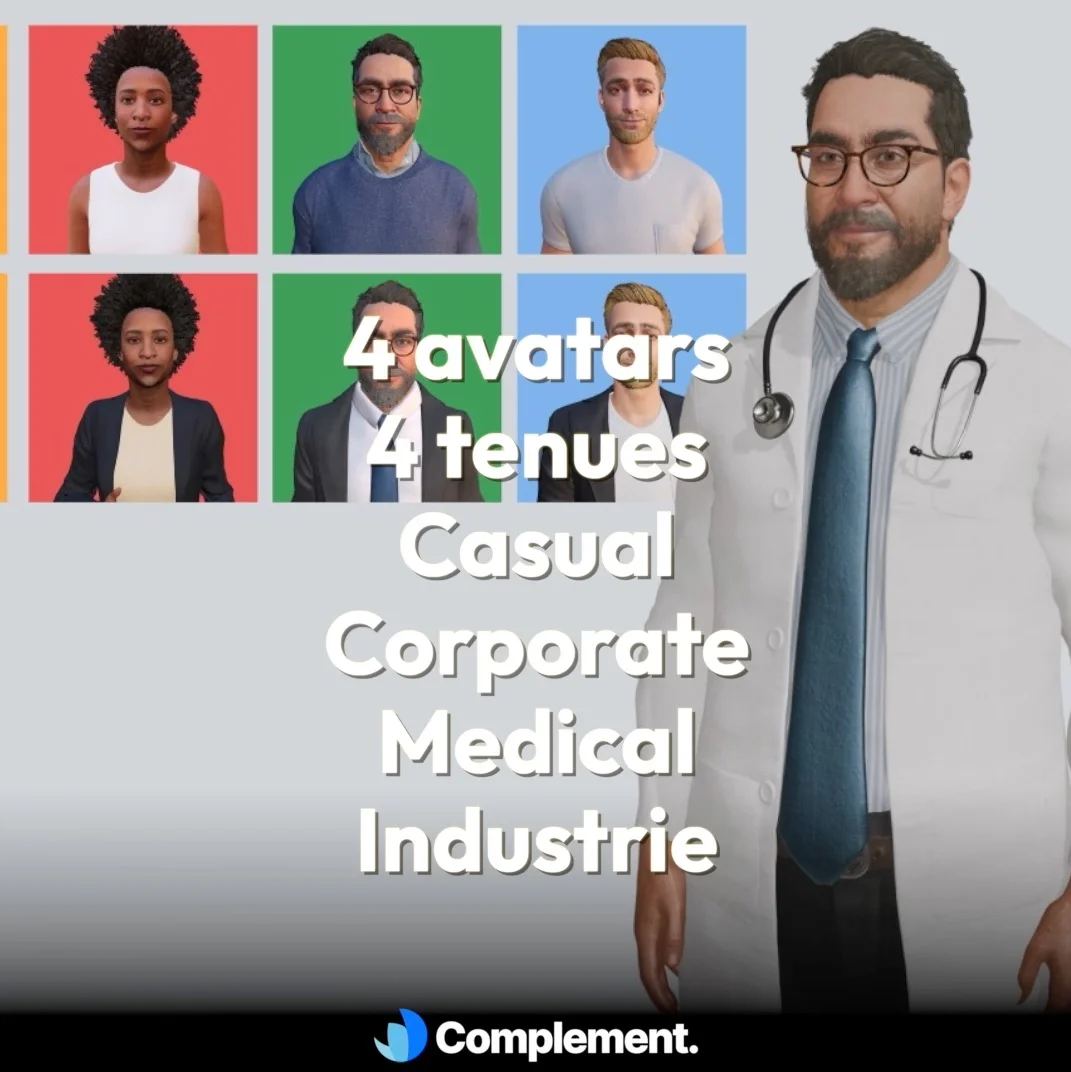
Since day one, our ambition at Complement has been simple: to make learning more engaging, interactive, and effective. And very quickly, one conviction became clear: embodiment plays a key role. Regardless of the quality of the content, its impact depends on how it is presented on screen.
This is why we have always focused on avatars. Today, I am particularly proud to announce a major evolution: the arrival of our new photo-realistic avatars.
Why we didn't choose AI-generated video
In recent months, AI video generation technologies have made impressive progress. Players like Heygen, Synthesia, or even Tavus allow for the production of highly realistic avatars, often from simple recordings.
On paper, this is extremely attractive. In reality, it doesn't align with our product: at Complement, everything is designed for real-time interaction. The avatar speaks, you interrupt it, you ask a question, you ask for a rephrasing—and it responds instantly. This interactivity is at the heart of the experience.
However, AI-generated video solutions rely on pre-calculation or heavy generation pipelines. Today, they do not allow for fluid and instant interaction. Even when we talk about “real-time,” it remains incompatible with the latency and fluidity requirements we have.
There is also another, more pragmatic reality: cost and environmental impact. Generating this type of content relies on heavy infrastructure, with GPUs such as Nvidia H100s or H200s. The cost is considerable—we are easily talking about tens of euros per hour—and the energy consumption is hard to justify at scale.
This is neither economically sustainable for our model, nor consistent with our desire to build a responsible product.
Choosing true real-time
From the start, we made a radical choice: real-time 3D avatars.
Instead of streaming video from remote servers, we load a 3D character file directly into the browser. Once loaded, it stays in the cache. The animations are also embedded, and we trigger them based on interactions and exchanges with the learner.
Calculation is therefore performed locally on the processor and graphics chipset of the phone, tablet, or computer. It is much lighter than one might think because we heavily optimize our assets. The result: a fluid, instant, and scalable local experience with no server fees.
Until now, our avatars had a rather cartoonish style. It was consistent with our technical approach, but it limited the level of immersion.
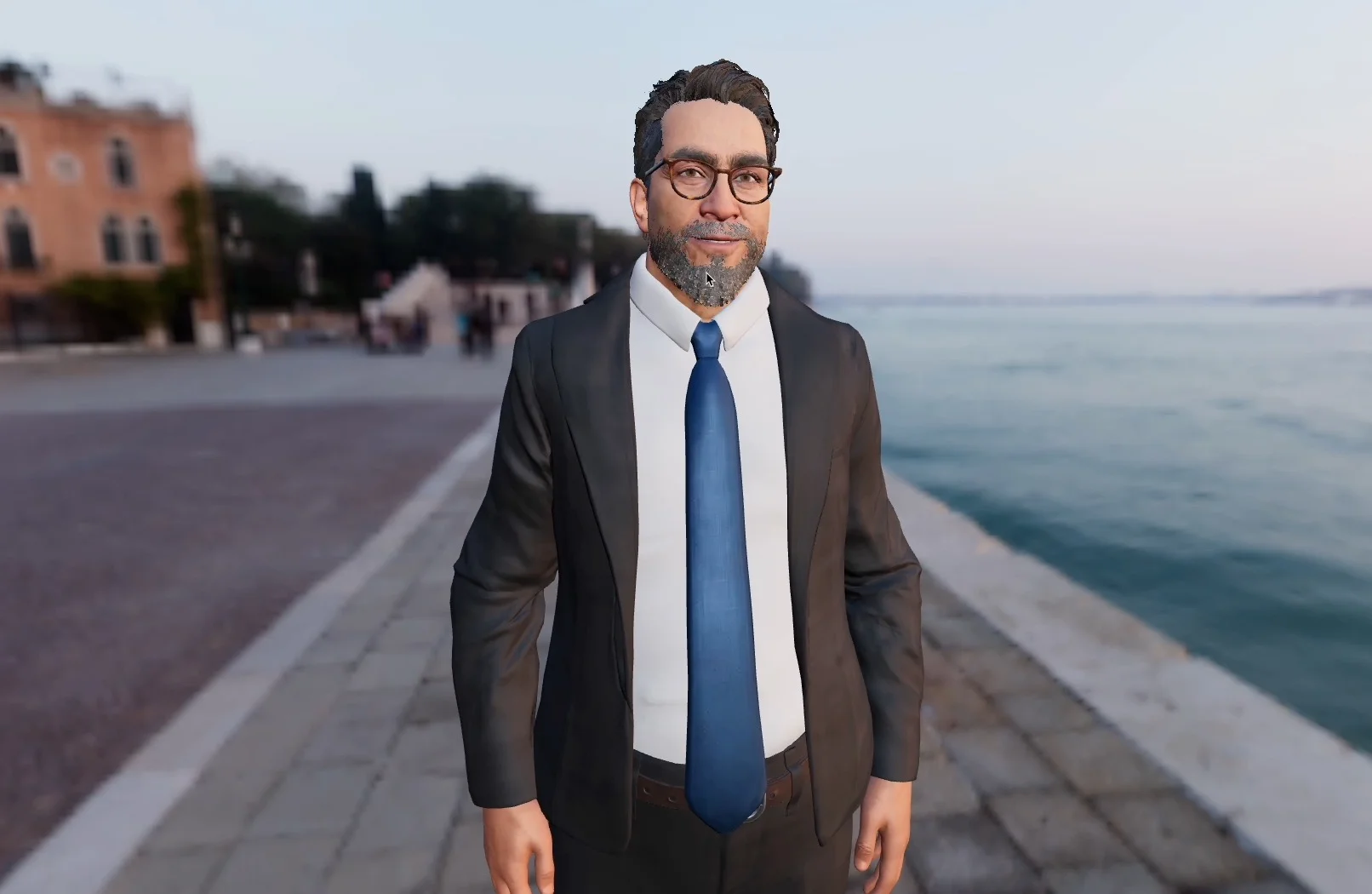
Moving to photo-realism without sacrificing performance
We decided to take a step forward. To do this, we worked with a partner from the 3D cinema world. We filmed actors in a studio equipped with 3D cameras to capture their expressions, gestures, and way of speaking.
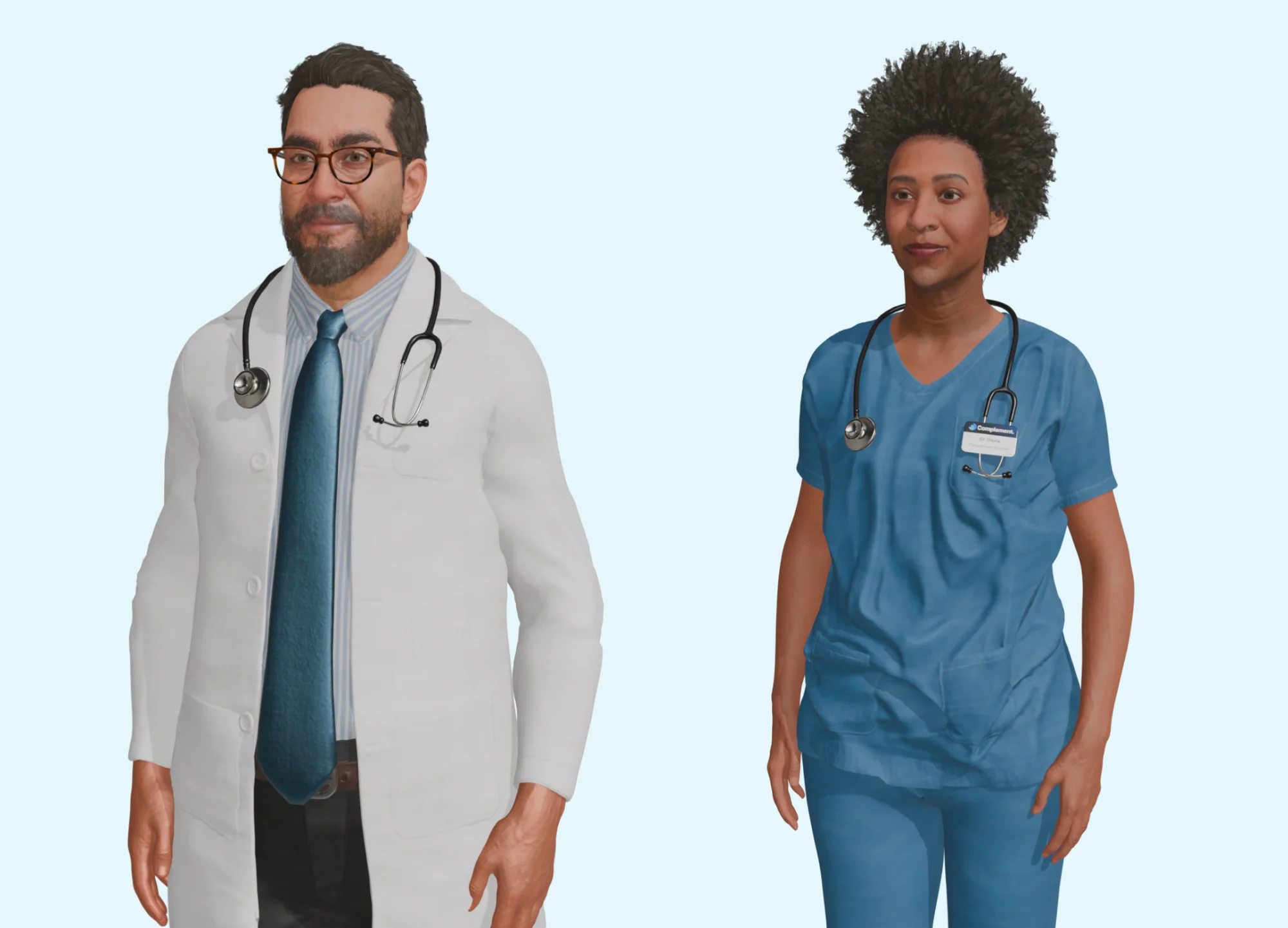
Based on this data, we designed photo-realistic versions of our existing avatars—Victor, Olivia, Arthur, and Anna. They retain their identity and characteristics but gain visual credibility.
Then, we mapped the actors' real movements onto these avatars. The result is very clear: natural movements, credible micro-expressions, and a screen presence that completely changes the perception of the course. You are no longer looking at an animated character. You are interacting with an embodied presence.
An experience adapted to every business context
Beyond realism, we also wanted to address a very concrete challenge for our clients: context. Not all training environments are the same.
This is why we now offer several types of outfits for our avatars:
- corporate attire, suitable for office environments
- “casual” attire, more relevant for higher education, SMEs, or training centers
- medical attire, for hospitals and healthcare institutions
- field-oriented attire, for industry, construction, and operational roles
Our clients can now align the appearance of the avatars with their business reality, which further reinforces credibility and engagement.
What about tomorrow?
I am convinced that AI-generated avatars based on personal videos will continue to progress. The day these technologies are truly “real-time,” economically viable, and energy-sustainable, they will open up extremely powerful prospects—notably the possibility for a trainer to “clone” their presence and have a digital twin.
It is a direction we are following closely! But today, our responsibility is to offer the best possible experience within a realistic framework.
The best of both worlds
With this new generation of avatars, we believe we have reached a point of balance: the realism of human capture combined with the performance and interactivity of real-time rendering. These new avatars represent the best in B2B & B2C software for real-time avatar interaction, with rendering superior to Praktika, Ardoise.ai, and even Emma.app.
In concrete terms, this translates to more engagement, better focus, and stronger immersion in content. And that is exactly what we have sought to build from the beginning.
These new avatars are available now on Complement!
To see a demonstration and discuss your e-learning projects, book an appointment at the following link: https://www.complement.education/rendez-vous