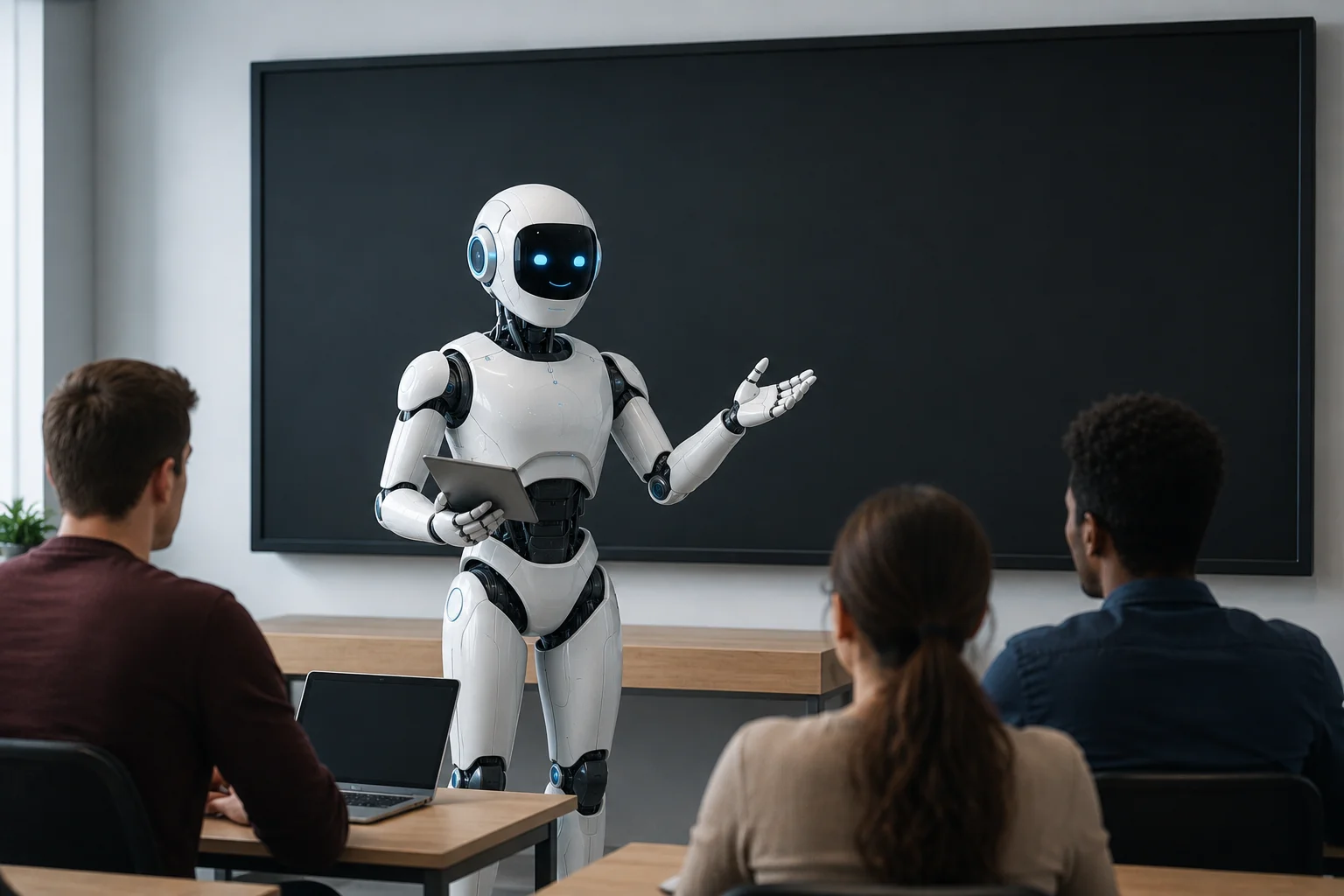
LEARNING IS NOT A ONE-SIZE-FITS-ALL EXPERIENCE
One of the greatest paradoxes of corporate training is that employees are all different, yet they are often expected to follow the exact same learning path.
Some are discovering a topic for the first time, others already have significant experience. Some learn best through practice, while others need more explanations, examples, or repetition.
Yet many training programs still deliver identical content, at the same pace, to everyone.
This standardization makes training easier to deploy at scale, but it also creates a growing gap between what learners actually need and the experience they receive.
THE PROBLEM IS NOT THE CONTENT
Organizations have never had access to so much learning content.
Learning libraries, LMS platforms, video courses, knowledge bases, and collaborative tools have made information more accessible than ever before.
Yet access to knowledge is no longer the primary challenge.
The real challenge lies in supporting each employee at the right moment, with the right explanation, the right feedback, and the right level of guidance.
Traditionally, this is the role of a coach.
A coach observes, questions, reframes, encourages, and adapts their support to the individual they are helping.
WHY HUMAN COACHING IS DIFFICULT TO SCALE
The benefits of coaching are well established : personalized interactions foster engagement, confidence, reflection, and skill development.
The challenge is that this model is difficult to scale.
Few organizations can provide every employee with continuous one-on-one coaching. Subject matter experts have limited availability, and managers face the same constraints.
As a result, there is often a gap between what we know is effective from a learning perspective and what organizations can realistically deliver.
THE EMERGENCE OF AI COACHES
Artificial intelligence is opening a new path forward.
Advances in conversational AI now make it possible to provide learners with continuous support that adapts to their responses, skill level, and progression.
The goal is not to replace human experts.
Instead, it is to replicate some of the elements that make individual coaching so effective: personalization, interaction, feedback, and adaptation.
An AI coach can ask questions, challenge assumptions, reformulate explanations, and propose additional exercises based on a learner’s specific needs.
Learning becomes much closer to a conversation than a simple content consumption experience.
LEARNING THROUGH DIALOGUE, NOT JUST THROUGH CLICKS
This shift is particularly important in a world where many digital learning experiences remain largely passive. Learners watch videos, read documents, and complete standardized quizzes.
With an AI coach, learners become active participants in their own development.
They explain concepts in their own words, justify decisions, answer open-ended questions, and respond to realistic situations.
Cognitive science research has consistently shown that active learning improves understanding, retention, and knowledge transfer far more effectively than passive exposure to information.
In this context, dialogue itself becomes a powerful learning tool.
PERSONALIZATION AT A SCALE NEVER BEFORE POSSIBLE
One of the most valuable contributions of an AI coach is its ability to personalize learning at scale.
Two employees following the same program may receive completely different interactions depending on their answers, mistakes, or level of mastery.
One learner may need additional explanations and practice opportunities, while another may be ready for more advanced scenarios and challenges.
This continuous adaptation helps solve two common problems in corporate learning: boredom among experienced learners and disengagement among beginners.
THE COMPLEMENT APPROACH: AN AI TUTOR THAT ADAPTS TO EVERY LEARNER
Complement provides a conversational AI tutor capable of supporting each learner throughout their journey. Interactions evolve according to responses, challenges encountered, and demonstrated progression.
Learners can interact verbally, ask questions, receive contextualized feedback, and engage with scenarios that closely reflect their professional reality.
This approach recreates some of the dynamics of individual coaching while maintaining the scalability required by modern organizations.
The objective is not simply to deliver knowledge, it is to help every learner progress at their own pace.
THE FUTURE OF LEARNING MAY BE MORE HUMAN THAN WE EXPECT
At first glance, artificial intelligence might appear to create greater distance between learners and human interaction.
But when applied thoughtfully to learning, the opposite may be true.
By personalizing interactions, adapting learning journeys, and supporting individual progression, AI can bring learning closer to what people have always needed: guidance tailored to their specific needs.
The question is no longer whether AI can generate content.
The real question is whether it can help every employee learn as if they had a dedicated coach by their side.
- Bloom, B. S. l The 2 Sigma Problem
- Bransford, Brown & Cocking l How People Learn
- OECD l The Future of Education and Skills
- World Economic Forum l Future of Jobs Report
- McKinsey l The State of AI